Trump and Tariffs
Author: Bill Chapman: email
In 1776, Adam Smith, a Scotsman, published the terrific book "Wealth of Nations" about economics. One thing discussed was how governments in his time all were enthusiastic about imposing tariffs on goods imported from other countries, and probably the strongest opinion in the book was that this was the wrong approach, governments should negotiate to lower or eliminate the tariffs, and increased mutual prosperity would result.
One example of this was that, in his time, it was possible to
grow wine in greenhouses in Scotland, but this cost 200 times as
much as growing wine in the south of France. Rather than
imposing tariffs on French wine to protect their domestic
market, the Scots should raise sheep, sell the wool, and use the
money to buy French wine.
The 1984 American presidential election was between Walter Mondale and Ronald Reagan. Mondale wanted massive tariffs, and Reagan didn't. Reagan won in a 49-state landslide, which ushered in an era of several decades of globalist economics. There were winners and losers from this.
Slowly, most of the American economy was able to shift from goods to services, the fraction of Americans with college degrees who no longer needed low-skilled factory jobs rose, and the availability of cheap goods from the third world rose the American standard of living.
Trump was elected, partly from the support of the losers from
globalism and partly for other reasons. Last spring, on
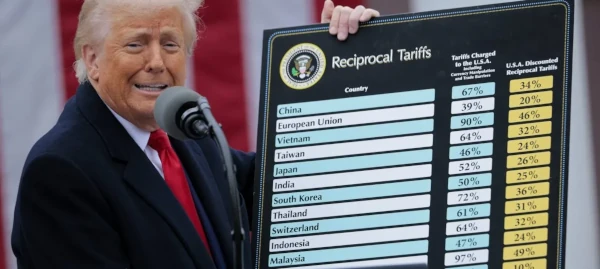
"Liberation Day", he went on TV with a sign listing very high
figures for tariffs imposed on the US by other countries. Like
much of what he says, this was a flat-out lie -- these figures
were not the actual tariff rates, but calculated
by some strange equation based on the balance of trade (and
contrary to his reasoning, an imbalance of trade is not proof of
unfairness).
Economists are virtually unanimous that Trump's tariffs are a bad idea: "Showing unusual unanimity, none of the more than 300 economists polled April 1-28 said tariffs had a positive impact on business sentiment, with 92% saying 'negative'. Only 8% said 'neutral', mostly from India and other emerging economies.".
It is clear from Trump's own rhetoric that one of his key motivations for imposing such destructively high tariffs was so that other countries would come pleading for him to reduce them, which he usually did, but only in return for sycophantic flattery. Trump thrives on insincere praise coming from weak parties motivated by fear.
Trump imposed a particularly high tariff on Switzerland, partly
because the Swiss president "rubbed him the wrong way" in a
meeting, then lowered it again after he had been given gifts including a Rolex watch
worth tens of thousands of dollars and an engraved gold bar.
One goal of the tariffs is to reverse globalization and allow American domestic manufacturing to re-grow, protected from cheap third-world labor by the tariffs. But nobody will invest in building factories, which will take many years of production to pay off the capital investment to build them, that can't survive open competition from the third-world, when the tariffs are extremely unlikely to survive the Trump presidency -- the economics profession is basically unanimously opposed, the only people who really want these tariffs are Trump himself and a couple of his hand-picked kooky economists on his cabinet.
In October, one state within Canada ran a TV commercial showing an accurate video of Reagan expressing a dislike of tariffs, and Trump lied about Reagan and canceled trade negotiations with all of Canada in retaliation.
The law that Trump was using to justify his imposition of tariffs contained a very specific and explict list of what measures he could take, and "tariffs" was not among them. He was claiming that there was some sort of "economic emergency" that justified his actions. He never articulate what, exactly, this so-called "emergency" was, and the way he was levying these tariffs was clearly so arbitrary, impulsive, and often related to petty personal animosity that they were clearly not motivated by any coherent economic strategy.
The Supreme Court ruled that the law that Trump was using to authorize his tariffs did not give him that power, so the tariffs vanished. Trump found another law to impose global tariffs on all other countries equally, and only for 150 days. A tariff for 150 days is not long enough for anyone to build a factory and run it long enough for it to pay for itself. One benefit of this tariff will be to raise revenue to make up for last year's tax cut. But at least Trump has been stripped of the authority to impose tariffs varying day-by-day at his whim to extort every other country in the world into lavishing insincere fawning praise and outright bribes on him.
I think that there is a flaw in the thinking of Adam Smith and the 300 economists polled by Reuters -- "free trade" is beneficial, but comes with a drawback -- once international supply chains are developed at great expense, trade give your trading partners leverage over you, and if your trading partners are bad actors like Trump who will use that leverage maliciously, that is a great vulnerability.
It is clear that Trump's approach to all relationships, whether they be with people or nations, is to use any leverage he has to humiliate, demean, dominate, and subordinate the other party, and quickly punish anyone who so much as gives him a dirty look. He will use any leverage he has to accomplish that. His actions over the last year have made it abundantly clear to the whole planet that all nations should do everything they can to reduce the leverage the United States has over them.